Why Do I Wake Up at 3 AM? Cortisol, Stress, Light, and Late-Night Habits Explained

Dr. Jonathan Moustakis
Co-founder and CTO of Lume Health

2 min read

Waking up at 3 AM does not automatically mean you have a cortisol problem. Around this time of night, sleep naturally becomes lighter, as REM sleep begins to predominate, and your stress system begins to gradually ramp up in preparation for waking. As a result, events that would not have disturbed you earlier in the night can now more easily overcome your remaining sleep pressure and cause you to wake up. In other words, your body is naturally easier to wake up at 3 AM, and that's why you are waking up at 3 AM. The cause for your waking may be there throughout the night.
That means that all the usual suspects: alcohol, a late meal, medication, insomnia, sleep apnea, or our favourite topic here at lume- poor light habits- need to be examined. Let's go through these…

A lot of people say, “Wine helps me fall asleep.” That can be true in the short term. But the deeper story is that alcohol changes sleep architecture. Recent review data suggest that even low doses can reduce REM sleep, while higher doses may help you fall asleep faster but cause greater sleep disruption later in the night. In plain English: alcohol may help you pass out faster, but it often leads to a messier second half of the night, with more frequent awakenings and poorer sleep quality.
The extent to which alcohol affects sleep varies considerably between individuals. Factors such as the amount consumed, timing, body size, sex, genetics, and metabolic rate all influence how quickly alcohol is cleared from the body and how disruptive it is to sleep. Because of this variability, it's difficult to give one-size-fits-all advice. However, many experts recommend avoiding alcohol for at least three hours before bedtime. That said, some people may benefit from avoiding alcohol for even longer, or abstaining altogether.

Then there is medication. Some antidepressants can be activating. Beta blockers may interfere with sleep in some people. Nasal decongestants can be stimulating. Steroids can mimic a stress-like signalling and promote wakefulness. Diuretics may not change sleep architecture directly, but they will absolutely wake you if they push you to the bathroom at 3 AM. If the pattern started after a prescription change, take that clue seriously- a change in the time you take your medication can make the world of difference.

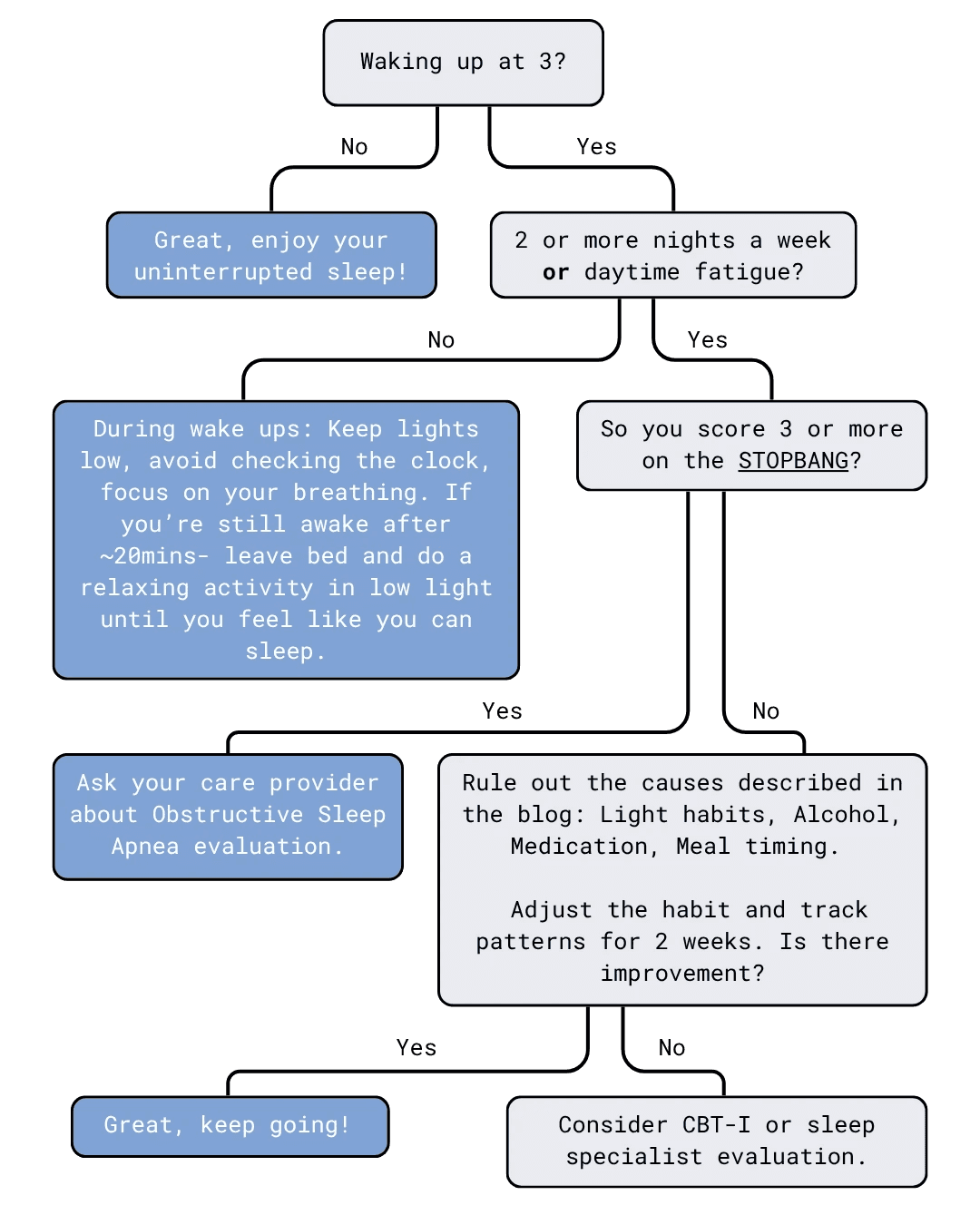
Obstructive sleep apnea is a common cause of abrupt awakenings during the night, and early diagnosis is critical to prevent the long-term consequences of the condition. The STOP-Bang questionnaire is a validated screening tool that can help assess your risk of obstructive sleep apnea. If your STOP-Bang score is 3 or higher, consider discussing the results with your healthcare provider, as you may benefit from further evaluation. I recommend that everyone reading this completes the screening questionnaire above; it takes less than a minute.
Late eating can have a similar effect, although the evidence is somewhat mixed. Observational studies suggest that eating within three hours of bedtime is associated with more frequent nocturnal awakenings, and later meal timing has been linked to poorer sleep quality. Controlled laboratory studies indicate that the effect is not always dramatic across the entire night, but late meals can still alter the balance between deeper and lighter stages of sleep.
If you regularly eat a large meal close to bedtime and are struggling with sleep, it's worth considering that meal timing may be contributing to the problem.
The same is true for fluid intake. If you frequently wake during the night needing to urinate, reducing fluid consumption in the hours before bed may help improve sleep continuity.
We live in a world where cortisol gets blamed for everything, from 3 AM awakenings to acne breakouts. While cortisol has many important effects throughout the body and is one of the gold-standard markers of circadian rhythm timing, it is not always the culprit.
I also want to address a common misconception: high cortisol is not always bad. In fact, a cortisol spike within roughly 30–45 minutes of waking, the Cortisol Awakening Response, is generally considered a sign of a healthy, well-functioning circadian system. Cortisol is, after all, a stress hormone, and waking up is often one of the most physiologically demanding stresses your body experiences each day.
What can happen, however, is that this cortisol rise occurs too early. If your circadian rhythm is shifted earlier than desired (known clinically as advanced sleep phase disorder), the associated increase in cortisol and alertness may contribute to waking up earlier than you'd like.

Fortunately, one of the most effective treatments is improving your light hygiene. Focus on getting natural sunlight—ideally outdoors—soon after waking, obtaining plenty of light exposure throughout the afternoon, and minimizing bright artificial light after sunset. Light is one of the strongest regulators of the circadian system and one of the most powerful levers you have to influence cortisol timing and overall sleep quality.
Almost everyone wakes up during the night from time to time. If you do wake up at 3 AM, do not turn it into a test. Don't start staring at the clock, calculating how many hours and minutes of sleep you would get if you fell asleep right NOW. Don't grab your phone and doom-scroll. Just try to relax, and if you are not back asleep within ~20 minutes, get out of bed and do something relaxing in dim light until you feel sleepy again. You do not want your bed to become a place where your brain practices being awake.
If the waking pattern has lasted for months or if you are experiencing fatigue, irritability, poor concentration, or morning headaches, it may point to a more significant disruption that warrants further investigation. I've put together the flowchart below to help identify the most appropriate next steps and rule out some of the biggest sleep saboteurs outlined above.
FLOW Diagram
If this was helpful, join the Lume waitlist and be first to hear when our cortisol and circadian tracking wearable becomes available.
Dr. Jonathan Moustakis
Co-founder and CTO of Lume Health